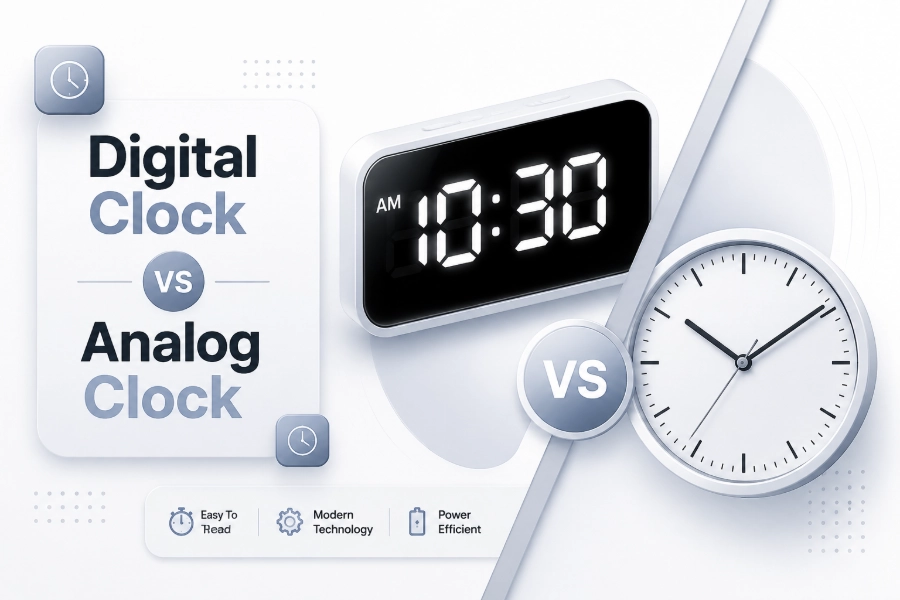
Clocks have been an essential part of daily life for centuries, helping people manage schedules, track important events, and organize their routines. While traditional analog clocks have been used for generations, digital clocks have become increasingly popular because of their modern features and easy-to-read displays. The comparison of digital clock vs analog clock often depends on personal preference, purpose, and the environment where the clock is used.
Both clock types perform the same basic function: showing the current time. However, the way they display time, how people read them, their design, and additional features can be very different. Analog clocks use moving hands and numbers on a circular face, while digital clocks show time using numbers on an electronic display.
Choosing between a digital and analog clock depends on factors such as readability, learning needs, style, accuracy, and extra functions. This guide explains the main differences between these two popular clock types and helps you decide which one fits your needs.
What Is an Analog Clock
An analog clock is a traditional timepiece that displays time using rotating hands on a circular clock face. It usually has three hands: an hour hand, minute hand, and second hand. The position of the hands shows the current time based on numbers or markers around the clock.
Analog clocks have been used for hundreds of years and remain popular because of their classic appearance. They are commonly found in homes, schools, offices, and public places because they combine functionality with decorative design.
How Analog Clocks Work
Analog clocks measure time through a mechanical or electronic movement system. The internal mechanism controls the movement of the hands at a consistent speed.
Mechanical analog clocks use gears and springs, while modern quartz analog clocks use battery-powered technology for accurate timekeeping. Both systems provide a visual representation of time through hand movement.
What Is a Digital Clock
A digital clock displays time using numerical digits instead of moving hands. Most digital clocks use LED or LCD screens to show hours, minutes, and sometimes seconds in a format such as 10:30 AM or 22:30.
Digital clocks are widely used in homes, smartphones, computers, alarm clocks, and electronic devices. Their clear number-based display makes them easy to read quickly, especially from a distance.
How Digital Clocks Work
Digital clocks use electronic circuits and timekeeping components to calculate and display the current time. Many models use quartz crystal technology to maintain accuracy.
Advanced digital clocks may include additional features such as alarms, calendars, temperature displays, timers, and automatic time adjustments.
Digital Clock vs Analog Clock: Main Differences
The biggest difference between digital and analog clocks is how they display time. Analog clocks represent time visually through hand positions, while digital clocks show exact numbers.
Each design offers different benefits. Analog clocks can help people understand the relationship between hours and minutes, while digital clocks provide faster time reading without requiring interpretation.
| Feature | Digital Clock | Analog Clock |
|---|---|---|
| Time Display | Numbers | Moving hands |
| Reading Speed | Faster for many users | Requires interpretation |
| Design Style | Modern | Classic |
| Learning Value | Lower for clock education | Helps teach time concepts |
| Extra Features | Often includes alarms and timers | Usually fewer features |
| Power Source | Battery or electricity | Battery, mechanical, or electric |
Accuracy Comparison Between Digital and Analog Clocks
Accuracy is an important factor when comparing digital and analog clocks. Modern digital clocks are often highly accurate because they rely on electronic timekeeping systems.
Analog clocks can also be very accurate, especially quartz models. However, mechanical analog clocks may require regular adjustment because small variations in movement can affect timekeeping.
Which Clock Keeps Better Time
For everyday use, both types can provide reliable time. Digital clocks often have an advantage because they display precise numbers and may automatically adjust using radio signals or internet connections.
Analog clocks remain accurate when properly maintained. High-quality quartz analog clocks can keep time with very little difference over long periods.
Ease of Reading Digital and Analog Clocks
Digital clocks are usually easier to read because they display the exact time in numbers. Users do not need to calculate the position of clock hands, making them convenient for quick time checks.
Analog clocks require understanding the relationship between the hour hand and minute hand. While this may take practice, it provides a stronger visual understanding of how time passes.
Learning Benefits of Analog Clocks
Analog clocks are commonly used in schools because they help children learn:
- How hours and minutes work together.
- The concept of elapsed time.
- The difference between AM and PM.
- Time intervals between events.
Digital clocks are useful for quick reading but provide less practice with traditional time concepts.
Design and Appearance Differences
The choice between a digital clock and an analog clock often depends on style preferences. Analog clocks are valued for their classic appearance and ability to complement home and office decoration.
Digital clocks usually have a modern appearance and are popular in bedrooms, workspaces, and technology-focused environments. Many include bright displays and customizable features.
Where Analog Clocks Work Best
Analog clocks are often preferred in:
- Living rooms.
- Offices.
- Classrooms.
- Traditional interior designs.
- Formal spaces.
Their timeless appearance makes them both practical and decorative.
Where Digital Clocks Work Best
Digital clocks are commonly used in:
- Bedrooms.
- Study areas.
- Workstations.
- Kitchens.
- Electronic devices.
Their clear display makes them convenient for quick time checks.
Features Comparison Between Digital and Analog Clocks
Modern digital clocks often include features that traditional analog clocks do not provide. These additional functions make them useful for people who need more than simple timekeeping.
Analog clocks generally focus on simplicity and visual design rather than extra technology.
Common digital clock features include:
- Alarm functions.
- Countdown timers.
- Stopwatch options.
- Temperature displays.
- Calendar information.
- Automatic brightness adjustment.
Common analog clock benefits include:
- Simple operation.
- Decorative appearance.
- No complicated settings.
- Long-lasting design.
Advantages of Digital Clocks
Digital clocks provide several benefits that make them popular among modern users. Their numerical display makes checking time quick and straightforward.
They are especially useful for people who need precise time information, such as students, professionals, and individuals managing busy schedules.
Benefits of Digital Clocks
- Easy-to-read number display.
- Often includes useful extra features.
- Good visibility in low-light conditions.
- Simple alarm settings.
- Convenient for modern environments.
Digital clocks are also commonly integrated into smart devices, allowing users to connect alarms, reminders, and other time-related functions.
Advantages of Analog Clocks
Analog clocks continue to remain popular because of their simplicity and visual appeal. They provide a traditional way of viewing time and can serve as attractive decorations.
Many people prefer analog clocks because they create a classic atmosphere while still providing reliable timekeeping.
Benefits of Analog Clocks
- Classic and elegant design.
- Helps develop time-reading skills.
- Works well as home decoration.
- Simple and easy to maintain.
- Available in many styles.
Which Clock Is Better for Students
For children learning how to tell time, analog clocks are often more beneficial. They help students understand how minutes, hours, and time intervals work together.
However, digital clocks can also be helpful after students understand basic time concepts. They allow faster reading and are common in everyday technology.
Which Clock Is Better for Daily Use
The better choice depends on your personal needs. If you want quick time reading and additional functions, a digital clock may be the better option.
If you prefer traditional design and want a clock that adds style to a room, an analog clock may be more suitable. Many people use both types depending on the situation.
Digital Clock vs Analog Clock: Final Comparison
| Category | Better Choice |
|---|---|
| Quick time reading | Digital clock |
| Learning time concepts | Analog clock |
| Modern features | Digital clock |
| Home decoration | Analog clock |
| Simple design | Analog clock |
| Alarms and timers | Digital clock |
Conclusion
The choice between a digital clock and an analog clock depends on your lifestyle, preferences, and intended use. Digital clocks offer quick reading, modern features, and precise displays, making them useful for busy schedules and technology-focused environments.
Analog clocks provide a traditional design, visual understanding of time, and decorative value that many people still appreciate. They remain an important tool for teaching time concepts and adding style to homes and offices.
When comparing digital clock vs analog clock, neither option is universally better. The right choice depends on whether you value convenience and features or simplicity and classic design.
FAQ
Which is more accurate digital or analog clock?
Digital clocks are generally more accurate because they use electronic systems for timekeeping. However, high-quality quartz analog clocks can also maintain accurate time with minimal adjustment.
Are analog clocks better for learning time?
Yes, analog clocks are often better for learning because they help children understand the relationship between hours, minutes, and seconds through visual hand movement.
Why are digital clocks easier to read?
Digital clocks display exact numbers, so users can quickly identify the time without interpreting the position of clock hands.
Do digital clocks use more power than analog clocks?
Digital clocks may use more power because they require electronic displays, while many analog clocks use simple battery-powered mechanisms.
Can analog and digital clocks show the same time?
Yes, both clock types show the same time. The difference is only in how the information is displayed.
0 Comments